
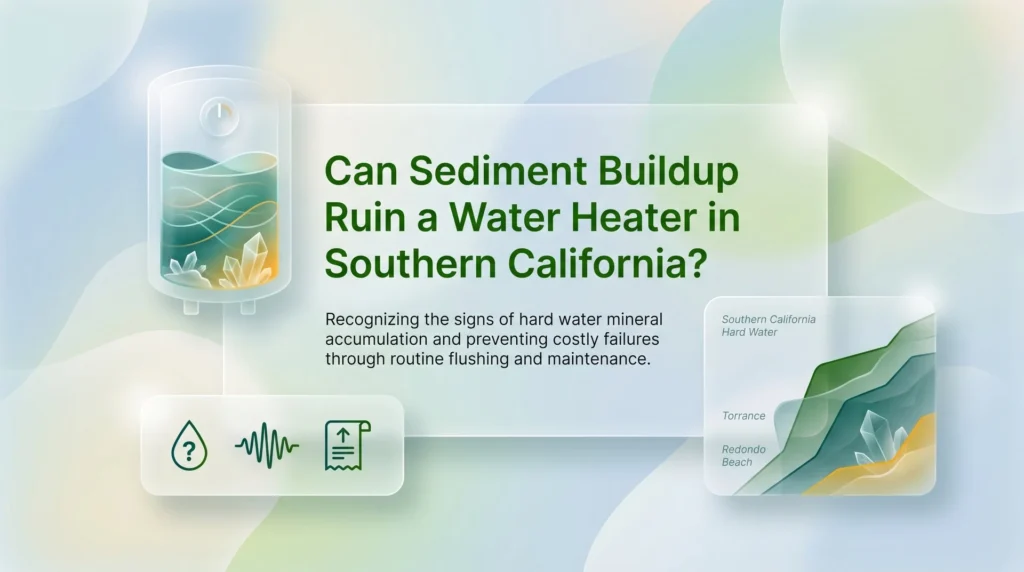
Sediment buildup from Southern California‘s hard water is a leading cause of premature water heater failure, as dissolved minerals like calcium and magnesium accumulate inside tanks in cities like Torrance and Redondo Beach. Homeowners who recognize early warning signs—lukewarm water, rumbling sounds, and rising energy bills—can prevent costly replacements through routine flushing and professional maintenance.
You’re standing in the shower, waiting. The water’s been running for two minutes and it’s still lukewarm. Or maybe you’ve noticed a low, almost rhythmic rumbling coming from the garage where your water heater lives. You chalk it up to the house settling, or maybe just an old unit doing its thing. But in many South Bay homes, that sound is a warning.
What’s happening inside that tank is something most homeowners never think about until it’s too late. The water flowing through your pipes in Torrance, Redondo Beach, Manhattan Beach, and across the greater South Bay carries dissolved minerals every single day. Calcium carbonate, magnesium, and other naturally occurring compounds travel invisibly through your supply lines and into your water heater, where heat causes them to precipitate out of solution and settle as scale on the surfaces that matter most.
To answer the question directly: yes, sediment buildup is one of the most common reasons water heaters fail prematurely in Southern California. It’s not dramatic or sudden. It happens quietly over months and years, degrading efficiency, shortening equipment life, and eventually causing failures that range from lukewarm showers to flooded garages. The good news is that understanding the problem is the first step toward preventing it. This article covers why local water conditions make this worse than in most of the country, what the damage actually looks like inside your system, how to recognize early warning signs, and what you can do to protect your investment.
Why South Bay Water Is Especially Hard on Water Heaters
Southern California has a well-documented hard water problem. The U.S. Geological Survey classifies much of the region’s water supply as hard to very hard, with mineral concentrations frequently exceeding 150 mg/L of calcium carbonate. That’s not a minor distinction. Water at that mineral concentration behaves very differently inside a water heater than the softer water found in many other parts of the country.
The South Bay area draws from a combination of local groundwater wells and imported water delivered through the Metropolitan Water District. Both sources carry significant mineral loads. When that water enters your water heater and gets heated, the dissolved minerals lose their ability to stay in solution and fall out as solid deposits. It happens every time your heater fires, every single day.
Galvanized Pipe Corrosion
But the mineral content of the water is only part of the story. In many South Bay homes built between the 1950s and 1970s, the original galvanized steel supply lines are still in place. Galvanized pipe corrodes from the inside out over time, introducing rust flakes and additional particulate matter into the water before it even reaches the heater. So you’re not just dealing with mineral scale. You’re dealing with mineral scale mixed with rust and debris from aging infrastructure. That combination accelerates sediment buildup considerably compared to newer construction with copper or PEX supply lines.
Coastal Factor
Then there’s the coastal factor. Homes near Manhattan Beach, El Segundo, and Hermosa Beach experience salt air exposure that most inland homeowners don’t think about. Salt air accelerates corrosion on water heater components, particularly on units installed in garages or outdoor enclosures. The exterior connections, pressure relief valves, and even the tank jacket itself can show corrosion damage faster than you’d expect. When a unit is already dealing with internal mineral scaling and external salt air corrosion simultaneously, the combined stress on the system is significant.
Humidity
Coastal humidity adds another layer. High ambient moisture can affect the combustion efficiency of gas water heaters and contribute to surface rust on components that might otherwise stay dry. In a climate that feels mild most of the year, it’s easy to forget that the marine layer rolling in off the Pacific carries real consequences for metal components and water-handling equipment.
The result is that a water heater in Torrance or Carson faces a harder working environment than the same unit installed in a drier, lower-mineral-content region. Manufacturer warranties and expected lifespans are often based on average water conditions, which means local homeowners should consider high-efficiency water heaters designed to handle tougher conditions rather than assuming their unit will perform as advertised without accounting for what’s actually flowing through it.
What Sediment Actually Does Inside a Tank Water Heater
Picture the inside of your water heater tank. Cold water enters through the dip tube and settles toward the bottom, where the gas burner or electric heating element applies heat. In a clean tank, that heat transfers efficiently and directly into the water. But in a tank with sediment buildup, something else is happening at that critical point of contact.
Minerals settle to the bottom of the tank because that’s where the water is coolest and where gravity does its work. Over time, those deposits compact into a layer that sits directly between the burner and the water. That layer acts as an insulator. Heat that should be going into your water is instead getting absorbed by sediment that’s doing nothing useful. The burner has to run longer to achieve the same result, which means higher energy consumption and more wear on the heating components.
The popping, rumbling, or knocking sounds that homeowners sometimes hear from their water heater are actually steam bubbles. As the burner heats the tank floor through that sediment layer, water trapped beneath the compacted mineral deposits gets superheated and turns to steam, which then forces its way up through the sediment. That noise isn’t just annoying. It’s one of the signs your water heater is failing and that the problem has already progressed to a point where the tank floor is experiencing thermal stress it wasn’t designed to handle.
Prolonged overheating of the tank floor creates hot spots. The steel and glass lining inside the tank is designed to operate within a normal temperature range. When localized areas of the tank floor get repeatedly overheated due to sediment insulation, the lining begins to crack and deteriorate. Once the protective lining fails, the steel itself is exposed to hot water and corrosion begins from the inside. This leads to pinhole leaks, which can start as a small drip at the base of the unit and progress to a full tank failure.
In many Torrance and Carson homes, the water heater lives in the garage or a utility closet. A slow leak that goes unnoticed for days or weeks can cause significant water damage to flooring, drywall, stored belongings, and even the structure itself. By the time the leak becomes obvious, the unit is usually past saving and the damage is already done.
The timeline from “minor sediment buildup” to “tank failure” varies depending on water hardness, usage patterns, and whether any maintenance has been performed. In the South Bay’s hard water environment, an unmaintained tank water heater can reach a critical state faster than most homeowners expect. It’s not a ten-year problem that announces itself gradually. Sometimes it accelerates quickly in the final stages.
More Water Heater Articles






Tankless Water Heaters Aren’t Immune to Mineral Scaling
Many homeowners upgrade to a tankless water heater specifically to avoid the problems associated with tank units. And tankless systems do offer real advantages. But hard water doesn’t care what kind of water heater you have. It just behaves differently inside a tankless unit than it does inside a tank.
Tankless water heaters heat water on demand by passing it through a heat exchanger, a dense network of fins and tubing where combustion gases or electric elements rapidly transfer heat. In hard water areas like the South Bay, mineral scale accumulates on those heat exchanger surfaces over time. Unlike sediment settling to the bottom of a tank, scale in a tankless unit coats the internal passages of the most expensive component in the system.
As that scale builds up, two things happen. First, the heat exchanger becomes less efficient at transferring heat, so the unit has to work harder to deliver the same water temperature. Second, the scale narrows the internal flow passages, reducing the volume of water that can pass through at any given moment. Homeowners sometimes first notice this as fluctuating water temperatures during a shower, or they start seeing error codes on the unit’s display panel without an obvious explanation. Understanding why tankless water heaters fail in South Bay homes can help you recognize these symptoms before they escalate into costly repairs.
Most tankless water heater manufacturers, including Rinnai and Navien, recommend annual descaling in hard water environments. That process involves circulating a descaling solution through the heat exchanger to dissolve accumulated mineral deposits. In the South Bay, where water hardness is consistently elevated, skipping professional tankless water heater maintenance isn’t just neglecting upkeep. It’s actively shortening the life of the unit.
A tankless water heater is designed to last 20 years or more with proper care. In hard water areas without regular descaling, heat exchanger failure in under 10 years is a realistic outcome. Replacing a heat exchanger is expensive. Replacing the entire unit is more so.
There’s also an installation factor worth mentioning. Some tankless units in older South Bay homes were installed on undersized gas lines, particularly in homes where the original gas infrastructure wasn’t upgraded to handle the higher BTU demand of a tankless system. An undersized gas line means the unit can’t achieve full combustion efficiency, which compounds the stress caused by mineral scaling. If you’ve had a tankless unit for several years and it’s never been serviced, a professional inspection is worth having before a small maintenance issue becomes a major repair.
Early Warning Signs Most Homeowners Miss
The challenge with sediment-related water heater problems is that the early signs are easy to rationalize away. Hot water takes a little longer in the morning? Must be the cold weather. Water isn’t quite as hot as it used to be? Maybe the thermostat drifted. The progression of symptoms is gradual enough that many homeowners don’t connect the dots until the problem is advanced.
Longer Recovery Time
Here’s how it typically develops. The first thing most people notice is a slightly longer recovery time. After someone showers, hot water used to return in ten minutes. Now it takes fifteen or twenty. That extended recovery time reflects the heater working harder to do the same job. Next comes lukewarm water at fixtures farthest from the heater, particularly in larger homes where the run from the water heater to the master bathroom is longer. The heater is producing hot water, but not as efficiently, and heat loss in the supply lines becomes more noticeable.
Discolored Water
Discolored or rusty-looking hot water is a more alarming sign, and it means corrosion is actively happening inside the tank. If the discoloration only appears in hot water and not cold, the source is almost certainly the water heater itself. Scheduling a water heater repair at this stage can sometimes prevent a full replacement. The audible popping or knocking described earlier follows as sediment compaction reaches the point where steam is being forced through mineral layers. By the time you’re hearing that noise regularly, the tank floor is already under stress.
Visible Leaking
Visible leaking at the base of the tank is the final stage before catastrophic failure. At that point, replacement rather than repair is almost always the right answer.
Slab Leak Confusion
In many South Bay homes with slab foundations, a failing water heater can create a diagnostic puzzle. Warm spots on the floor or unexplained moisture near the utility area can look like early slab leak symptoms. A slab leak and a failing water heater can produce similar surface signs, so proper diagnosis matters. Chasing a suspected slab leak when the real problem is a corroded water heater tank wastes time and money.
Reduced Water Pressure
One overlooked clue: reduced water pressure specifically at hot water fixtures, while cold water pressure remains normal. Sediment can partially block the heater’s outlet or degrade the dip tube, restricting hot water flow in ways that don’t affect the cold supply at all. If your hot water pressure has gradually gotten weaker over the past year or two, sediment is worth investigating as a cause.
Suspect a Water Heater Problem? Call us!
When Flushing Won’t Save It: Knowing When to Replace
There’s a point of no return with sediment damage, and it’s important to recognize it before investing money in a unit that can’t be saved. If a tank water heater is over eight to ten years old in a hard water area and has never been flushed or serviced, the sediment at the bottom is likely compacted to the point where a flush won’t fully remove it. More importantly, the tank lining may already be compromised from years of localized overheating. A professional can assess this, but the honest answer is often that flushing an old, neglected tank in the South Bay is a temporary measure at best.
The decision between repairing an aging unit and replacing it depends on several factors: the age of the unit, the condition of the tank lining, the extent of sediment accumulation, and whether the existing installation was done correctly in the first place. That last point matters more than people realize. Many older water heater installations in South Bay homes have issues that weren’t addressed at the time, including undersized gas lines, inadequate venting, or missing expansion tanks. An expansion tank is required in closed plumbing systems to manage thermal expansion, and many homes don’t have one. These installation deficiencies don’t just affect the old unit. They’ll cause problems with a new one too if they’re not corrected during a proper water heater installation.
Upgrading to a tankless system is worth considering at replacement time, particularly for homeowners who want longer equipment life and better energy efficiency. But a tankless water heater installation requires proper gas line sizing, appropriate venting, and a realistic understanding of the hard water maintenance commitment that comes with it. A professional assessment that looks at the whole picture, not just the water heater itself, gives you the information you need to make a decision that won’t result in the same problems five years from now.
Improper past installations are discovered regularly during water heater replacements in older South Bay homes. Addressing them at the time of replacement adds some cost upfront but prevents repeat failures and safety issues down the road.
Putting It All Together
Sediment buildup isn’t a minor inconvenience you can ignore until something breaks. In Southern California’s hard water environment, it’s the leading cause of premature water heater failure, and the South Bay’s combination of high mineral content, aging infrastructure, coastal humidity, and salt air exposure makes the problem more pronounced here than in most of the country.
The homeowners who get the most life out of their water heaters are the ones who treat maintenance as a regular habit rather than a crisis response. Annual tank flushing, anode rod inspection, and whole-home water quality improvements are the practical steps that keep a water heater running efficiently for its full expected lifespan. And when a unit is genuinely past its prime, getting an honest assessment from someone who knows local conditions saves you from throwing money at a system that’s already compromised.
At WiseWay Plumbing, we’ve been working in Torrance, Redondo Beach, Carson, Hawthorne, Long Beach, and across the South Bay for over 27 years. We know what Southern California water does to plumbing systems, and we know how to fix the root problem rather than just the symptom. Whether your water heater is making noise, losing efficiency, or you simply can’t remember the last time it was serviced, we’re here to give you a straight answer about where things stand.
Contact us to schedule a water heater inspection, maintenance flush, or honest assessment of whether your current unit still has life left. Our $0 service call with any plumbing repair means you’re not paying just to have someone show up. Schedule Service Now and let’s make sure your water heater is ready for whatever Southern California’s water throws at it.

Call Now!

Booking Online Is Easy!
More Expert Plumbing Advice




Practical Maintenance That Extends Water Heater Life in Hard Water Areas
The most straightforward maintenance task for a conventional tank water heater is an annual flush. The idea is simple: drain the tank to remove accumulated sediment before it compacts and causes damage. In practice, it’s a bit more involved than just opening the drain valve.
Most homeowners who attempt a DIY flush open the drain valve, let some water out, and assume the job is done. But in tanks with significant sediment buildup, the loose material at the bottom doesn’t always flow out through the drain valve easily. Compacted sediment may require a more thorough flush with the cold water supply running to agitate and suspend the deposits before they can be removed. A professional water heater maintenance service uses techniques to break up and fully evacuate sediment that a simple drain-and-refill approach often misses. That’s why many homeowners who “flushed” their water heater themselves still end up with sediment-related failures.
Whole-home water filtration and conditioning systems take a more proactive approach by addressing mineral content before it reaches the water heater, your pipes, and your fixtures. A well-matched water softener or filtration system can significantly reduce the mineral load entering your plumbing system. For older South Bay homes with aging galvanized supply lines and hard municipal water, this is one of the most effective long-term investments available. WiseWay Plumbing installs Halo whole home water filtration systems, which are designed to address the kinds of water quality issues common in Southern California. Reducing mineral content at the point of entry protects not just the water heater but every appliance and fixture in the home.
Anode rod inspection and replacement is the maintenance item most homeowners have never heard of. Every tank water heater contains a sacrificial anode rod, typically made of magnesium or aluminum, that’s designed to corrode in place of the tank itself. Corrosive elements in the water attack the anode rod first, protecting the steel tank. It’s a clever piece of engineering, but it only works if the rod is replaced before it’s fully depleted.
In hard water environments like the South Bay, anode rods deplete faster than in softer water regions. A rod that might last four to five years under normal conditions can be exhausted in two to three years in hard water. Once the anode rod is gone, the tank becomes the target. Corrosion accelerates, and the timeline to failure shortens considerably. Anode rod inspection should be part of any professional water heater service, but it’s rarely included in a basic maintenance call unless you specifically ask for it.
Fixing Plumbing Problems in The South Bay
and the Surrounding Communities
- 90001
- 90002
- 90003
- 90004
- 90005
- 90006
- 90007
- 90008
- 90010
- 90011
- 90012
- 90013
- 90014
- 90015
- 90016
- 90017
- 90018
- 90019
- 90020
- 90021
- 90023
- 90024
- 90025
- 90026
- 90027
- 90028
- 90029
- 90031
- 90032
- 90033
- 90034
- 90035
- 90036
- 90037
- 90038
- 90039
- 90041
- 90042
- 90043
- 90044
- 90045
- 90046
- 90047
- 90048
- 90049
- 90056
- 90057
- 90058
- 90059
- 90061
- 90062
- 90063
- 90064
- 90065
- 90066
- 90067
- 90068
- 90069
- 90071
- 90073
- 90077
- 90079
- 90089
- 90094
- 90095
- 90205
- 90210
- 90212
- 90220
- 90221
- 90222
- 90230
- 90231
- 90232
- 90233
- 90245
- 90247
- 90248
- 90249
- 90251
- 90254
- 90260
- 90261
- 90266
- 90267
- 90272
- 90274
- 90275
- 90277
- 90278
- 90290
- 90291
- 90292
- 90293
- 90294
- 90295
- 90303
- 90304
- 90310
- 90401
- 90402
- 90403
- 90404
- 90405
- 90406
- 90407
- 90408
- 90409
- 90410
- 90411
- 90501
- 90502
- 90503
- 90504
- 90505
- 90506
- 90507
- 90508
- 90509
- 90510
- 90620
- 90621
- 90622
- 90623
- 90624
- 90630
- 90638
- 90650
- 90651
- 90652
- 90680
- 90701
- 90702
- 90703
- 90706
- 90707
- 90710
- 90711
- 90712
- 90713
- 90714
- 90715
- 90716
- 90717
- 90723
- 90731
- 90732
- 90740
- 90742
- 90743
- 90744
- 90745
- 90746
- 90747
- 90749
- 90801
- 90802
- 90803
- 90804
- 90805
- 90806
- 90807
- 90808
- 90809
- 90810
- 90813
- 90814
- 90815
- 90822
- 90831
- 90832
- 90833
- 90840
- 90842
- 90844
- 90846
- 90847
- 90848
- 90895
- 91040
- 91042
- 91214
- 91303
- 91304
- 91306
- 91307
- 91311
- 91316
- 91324
- 91325
- 91326
- 91330
- 91331
- 91335
- 91340
- 91342
- 91343
- 91344
- 91345
- 91352
- 91356
- 91364
- 91367
- 91401
- 91402
- 91403
- 91405
- 91406
- 91411
- 91423
- 91436
- 91504
- 91505
- 91601
- 91602
- 91604
- 91605
- 91606
- 91607
- 91608
- 92605
- 92615
- 92646
- 92647
- 92648
- 92649
- 92655
- 92683
- 92684
- 92685
- 92703
- 92708
- 92728
- 92801
- 92802
- 92803
- 92804
- 92805
- 92806
- 92807
- 92808
- 92809
- 92812
- 92814
- 92815
- 92816
- 92817
- 92825
- 92840
- 92841
- 92842
- 92843
- 92844
- 92845
- 92846
- 92899
Don’t see your ZIP code? Call us to ask about service in your area. We may still be able to help.
(310) 731-1055